Last Edited: March 19, 2020
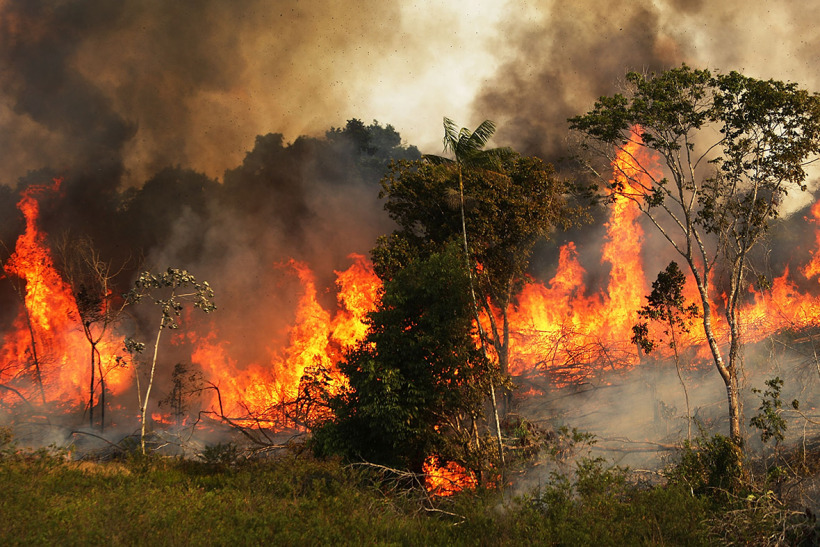
It is strange how the Amazon Rainforest, with an annual rainfall of 120 inches on average, would catch on fire in 2019. What are the drivers behind the wildfires and what are the impacts?
Let’s begin with the benefits of the Amazon Rainforest. The Amazon can brag about its biodiversity of over 100,000 animal and plant species. In addition, there are 1 million natives, grouped into 400 indigenous tribes who live with the land.
On a global scale, the Amazon river filters out 20% of global freshwater. Trees are key to cleaning the water for their roots divert harmful sediment and pollutants into the soil, and slowly release clean water into streams and rivers. Furthermore, the Amazon is one of the largest carbon sinks (an area that captures carbon) in the world, holding 78 billion tons of CO2, and capturing 5% of the world’s global emissions annually, according to apnews.com.
What are the Drivers?
Deforestation through slash-and-burn, and the impacted dead dry trees, made the Amazon more susceptible to wildfires. The drivers behind the wildfires are corporations that practice deforestation. According to ucsusa.org, while around 5% of deforestation in the Amazon are due to Logging and Other processes, at least 60% of deforestation is driven by cattle grazing. The remaining drivers are soy feed which is around 25%, and 10% for large scale farming. 18% of the Amazon Rainforest has been cleared, equivalent to the size of California, according to greenpeace.
Cattle Grazing
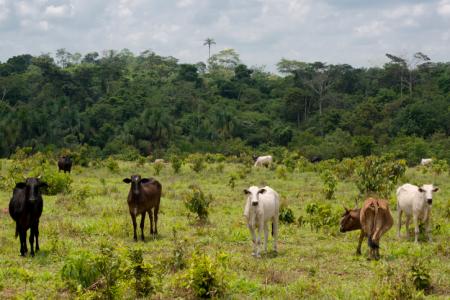
In order to gain land for cattle to graze on, the trees must either be slashed or burned. When cattle graze on the cleared areas, they compact the soil, and destroy the vegetation. With the absence of trees to absorb the impact of the rain, the rain sweeps away nutrients from the soil. Now the land is no longer fertile or usable, so the Amazon must be cut into deeper.
Have you ever driven past a cattle ranch and smelled the stench. Cows are ruminants, so when they digest food, they release Methane (CH4) into the environment as burps and farts. Methane is one of the major greenhouse gases, and can trap 19 times more UV rays; making it more potent than carbon dioxide. Methane accounts for 16% of global emissions according to the US EPA, yet the cattle industries emissions traps in equal amount of heat as the global transportation emissions.
Raising cattle from the feed is an inefficient process. From the soy feed that accounts for around 25% of deforestation, a large part goes into feeding the cattle and other livestock. Again, since cattle are ruminants, they are slow growers. To produce 1 calorie of beef, farmers must put in 8 calories of feed. With the need to produce large quantities of feed, it is estimated that to produce a pound of beef, 1800 gallons of water are used; this includes water pollution from pesticide and manure runoff into water systems.
JBS is the Brazilian company that primarily runs the cattle grazing, and is the biggest meat processing company in the world. When you eat beef where you don’t know the source, chances are you consumed the meat produced by JBS.
How to prevent the Rain-forest turning into a Rain-garden
The biggest powerplay you could perform to save the Amazon Rainforests is to reduce your beef consumption since it is the lead cause of deforestation. Beef production is a product demand situation. If a community avoids beef, the demand for beef goes down, which on a grander scale can lower production. An individual can begin with consuming beef once a week, to once a month, extending to only during occasions. Although plant-based proteins are ideal, switching out beef for poultry or fish is still a more environmentally friendly source of protein.
Other consumption changes an individual can make are purchasing FSC (Forestry Stewardship Council) approved furniture and products. Try to avoid products with palm oil; however, it is difficult since there are many ingredient names for them. Purchase products that include the Rainforest Alliance logo (a leaping frog).
Steps the Governments could take is utilizing the debt-for-nature approach. For example, in 2010, the US signed an agreement with Brazil under the Tropical Rainforest Conservation Act. This agreement converted $21 million of debt into funds towards protecting the endangered ecosystems.
Foundations that focus on restoring and protecting can be donated towards. Go to Rainforest Trust and Amazon Watch to support these causes. There will be a website that contains links to the organizations down below.
A method to sustainably profit off the Amazon is agroforestry. Agroforestry is the combination of farming under the cover of the trees. Agroforestry includes shade-grown coffee, cacao, with fruits and vegetables as secondary sources of income.
The final message is to share this knowledge with others, send them this article! As more people become aware, more positive change towards saving the Amazon can be done!
Links
To donate visit this website which will route you to the various orginizations: https://www.globalcitizen.org/en/content/organizations-donate-amazon-rainforest/
To see the chart that breaks down the drivers visit: https://rainforests.mongabay.com/amazon/amazon_destruction.html
To read about the impacts of cattle visit: https://www.washingtonpost.com/climate-solutions/2019/11/18/are-my-hamburgers-hurting-planet/?arc404=true
To learn about agroforestry visit: https://farmfolio.net/articles/agroforestry-comes-rescue-fight-amazon-rainforest-deforestation/\
To shop FSC visit: https://us.fsc.org/en-us/market/fsc-featured-products
As always feel free to leave any comment, questions or contradictions in the comment section down below!
 The Eco Soldier
Great article, ecosoldier!
LikeLiked by 1 person
Thanks for the feedback.
LikeLike
great content!
LikeLike
WOW. This article really shows the concerns about the Amazon rain forests and I could really learn more @theecosoldier .
LikeLiked by 1 person
There are many concerns around the Amazon but we can turn the concerns into action through each of their solutions.
Thanks for shouting out my new account on Instagram!
LikeLike
Very interesting. I hadn’t heard about the deal to convert debt to funds to protect the Amazon Rainforest. What about products that are made of cow byproducts? Like bones for dogs, milk, etc?
LikeLiked by 1 person
The US was the 16th country to sign a debt-for-nature agreement. The money went to protecting the Cerrado a rich grassland, The Atlantic Amazon, and The Caatinga, a dry northeastern rainforest; all of which were most critically endangered.
Dairy cows are not a primary deforestation driver in the Amazon since the cattle grazing is primarily for beef. However in the US dairy cows drive deforestation and excess resource consumption.
Around half of the cows bones can be sold as dog bones. Bones for dogs lead me to discover another issue: deadstock. Rendering plants, that have essentially recycled remains of cattle, have been closing down since 1987. With the main place to dump deadstock taken out of the picture, other alternatives must be explored.
The solutions include composting, digestion plants and well, buying dog bones. Composting deadstock would function as long as remains aren’t heavily concentrated in one compost pile. Digestion plants are were anaerobic bacteria break down the remains into biogas which can produce energy with zero emmisions. If furthur developed, this could prove a reliable source for renewable energy. Finally, while I initially believed buying a dog bone a negative impacting action, buying US cow bones can help the disposal of deadstock.
LikeLike
This is a great article! I can tell you put a lot of effort into making this.
Honestly, I find it unsettling that deforestation is mostly caused by cattle farming rather than other kinds of farming… I hope that one day, people find a solution to this before it’s too late.
LikeLiked by 1 person
Thank you, it is quite unsettling how one industry is behind the majority of this destruction. We can all hope for the best in the future, taking individual actions as well as pushing for strong governmental action.
LikeLiked by 1 person
“18% of the Amazon Rainforest has been cleared, equivalent to the size of California” This surprised me, it put the situatuon into perspective. Lots of information in this article, well done!
LikeLiked by 1 person
California is 40,469,445 hectares, according to CA.gov.
One hectare is about the size of the grass park within the track.
All this lush green forest… demolished into lifeless deserts.
LikeLike
beef can’t simply be replaced with other foods. but it looks like u put a lot of effort into making this, good job jared!!
LikeLiked by 1 person
If completely cutting it out is not your cup of tea, try reducing your beef consumption. You may also try alternatives such as the Beyond Meat burger.
Although a lifestyle change such as reducing beef may seem drastic, because “beef can’t simply be replaced,” remember that our earth can’t simply be replaced.
LikeLike